
Is Nuclear Saving the Day?
Investores are betting big on reactors that mostly exist in PowerPoint - meanwhile, the boring stuff that actually works is already humming.

Last week, nuclear stocks went on a run: Nano Nuclear Energy jumped eleven percent. MP Materials, which supplies the rare earths that advanced reactors need, surged eight and a half. NuScale Power and Oklo each added more than five percent. Siemens Energy and Nordex climbed too. The market message was unmistakable: investors are betting that nuclear power is about to have its moment.
The timing is not random. AI data centres are swallowing electricity at a rate nobody forecast. The Trump administration wants to quadruple American nuclear capacity by 2050. The U.K. is reviving old sites like Wylfa. The US Department of Energy is fast-tracking small modular reactors onto federal land. And just this week, the U.S. Nuclear Regulatory Commission opened an environmental review for Holtec’s plan to build two new SMRs. For a sector that has spent decades in the wilderness, the tailwinds are real.
The argument for nuclear is simple and seductive. Solar panels stop working when the sun goes down. Wind turbines stop when the air is still. Batteries can bridge the gap for hours, but not yet for days or weeks. Nuclear runs all the time, emits no carbon, and packs enormous power into a small footprint. If you need to keep a hyperscaler campus running twenty-four seven without burning gas, nuclear looks like the only adult in the room.
That is the bullish case, and it is not crazy. Existing nuclear fleets in France, the U.S. and South Korea have provided reliable zero-carbon baseload for decades. Keeping those plants open is cheaper and faster than building new ones. For certain industrial processes - steel, cement, chemicals - the high heat that advanced reactors can deliver may be genuinely hard to replace.
But here is where the enthusiasm starts to outrun the evidence.
The Price Problem
Lazard’s latest Levelized Cost Of Energy (LCOE) analysis, ranks utility-scale solar and onshore wind as the cheapest new sources of electricity for the tenth year in a row. Nuclear clocks in at roughly $140 to $220 per megawatt-hour, two to three times the cost of solar ($40-$80), and that is before you add storage. The only large new-build reactors finished in the United States this century, Vogtle 3 and 4 in Georgia, produce power at over $150 per megawatt-hour according to the DOE’s own Liftoff report. Ratepayers are on the hook for that gap for the next sixty years.
The British experience is even starker. Hinkley Point C was supposed to prove that Europe could still build nuclear. Instead it became a museum of cost overrun. The bill has swollen past £54 billion and is still climbing. Prof. Maximilian Fichtner, who directs the Helmholtz Institute Ulm and leads Germany’s delegation to the International Energy Agency, put it bluntly in a recent interview:
by the time Hinkley finally operates, the cost could reach £65 billion, rendering it “completely beyond usability.”
He points out that Flamanville in France, another flagship European project, is already producing electricity at double the market price.
The “PowerPoint Reactor” Problem
SMR supporters say factory production will solve this. But the Institute for Energy Economics and Financial Analysis looked at the actual projects and found the opposite. NuScale’s Idaho plant was cancelled after costs ballooned from $3.6 billion to $9.3 billion. Holtec and X-energy have both missed timelines. Fichtner’s verdict was sharper: the dozens of SMR designs being pitched to investors are mostly “PowerPoint reactors.” Only two SMRs are running anywhere in the world, and both are military. The economies of scale that would make them affordable only kick in after one thousand to five thousand serial units, a volume no Western country has even planned.

The Speed Problem
A solar farm goes from permit to power in under two years. An SMR needs most of a decade, even with political tailwinds. Every month spent waiting for concrete is another month coal or gas keeps spinning. Stanford’s Mark Jacobson argues that every dollar sent to nuclear is a dollar not spent on renewables that can cut emissions today. Fichtner adds a grid-level observation: when a large central plant trips offline, it tears a hole in the network. Distributed solar plus storage does not.
The Fuel Problem
Then there is the fuel problem. Russia’s Rosatom controls nearly half of global uranium enrichment. Kazakhstan mines more than forty percent of the raw uranium. The United States imports over ninety percent of its nuclear fuel. The advanced reactors everyone is excited about need HALEU, a fuel enriched far above current levels. There is exactly one commercial HALEU producer in the West, a demonstration plant in Ohio. The DOE says the U.S. will need forty metric tons per year by 2030. Current capacity is a fraction of that. One DOE awardee has already slipped its schedule because fuel is not available.
A nuclear build-out sold as energy independence could end up swapping Russian gas for Russian uranium. The European Union is trying to get off Russian nuclear fuel, but has no alternative supplier ready.
The Waste Problem
And then there is the inventory no spreadsheet likes to price: the waste. The United States still has no permanent repository. Taxpayers have already paid utilities $11 billion in damages for the government’s failure to take the waste, and the DOE estimates the total bill could hit $44 billion. SMRs produce less waste per unit of power, but they do not eliminate it. The physics has not changed.
The Proliferation Problem
Finally, the question almost nobody asks on the earnings call: proliferation. The same centrifuges that make reactor fuel can make weapons material. The Arms Control Association warned this year that eroding multilateral safeguards are stripping away the architecture that kept nuclear weapons confined to nine states. A world of small reactors exported to dozens of nations is also a world of enrichment know-how spread widely. That is not a reason to ban nuclear energy, but it is a cost that rarely appears in the investor deck.
What Already Works
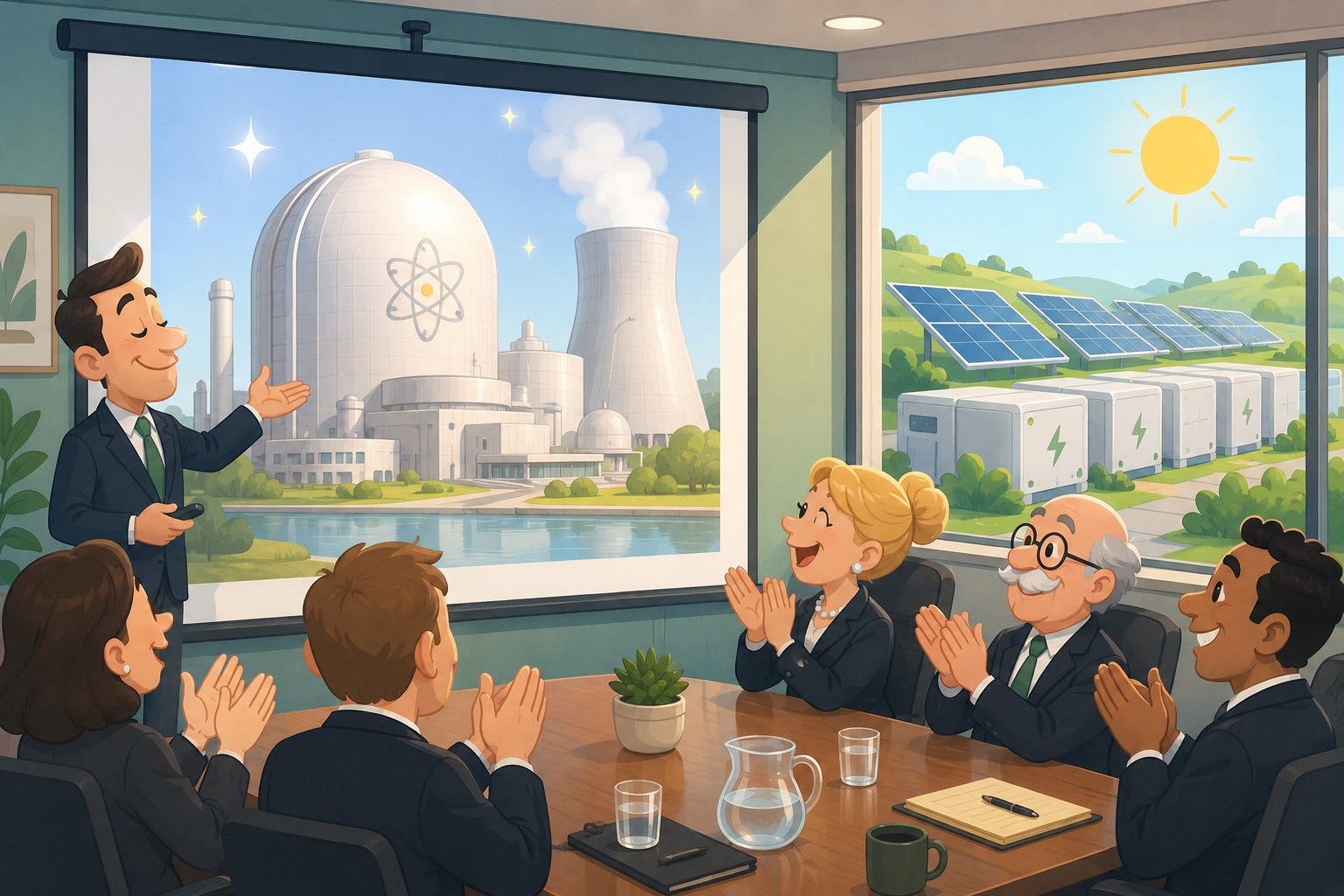
The most striking thing is what the nuclear boosters ignore. While they wait for reactors that do not yet exist, Abu Dhabi is already building the world’s largest solar-plus-battery plant. Masdar and CATL are putting up 5.2 gigawatts of solar paired with 19 gigawatt-hours of storage, designed to deliver one gigawatt of baseload power around the clock. It is privately financed, needs no subsidy, and will be running years before most celebrated SMR projects break ground. Fichtner, who spent twenty years researching hydrogen before switching to batteries, calls projects like this proof that the old objection - solar does not work without storage - is simply outdated. Storage is already here at grid scale.
So is nuclear saving the day? Not with the technology we have now, at the prices it actually costs, on the timelines we actually face. The market is pricing a future that the supply chain cannot deliver. Solar and wind are cheaper, faster, and already scaling. Batteries are closing the intermittency gap. Nuclear may deserve a seat at the table for specific niches - keeping existing plants open, perhaps some industrial heat - but as the main answer to the energy transition, it is a bet on a decade from now when we need answers today.
The real risk is not that nuclear fails. The real risk is that the nuclear hype diverts money and attention from the renewables that are already winning. The energy transition needs what works, not what sounds exciting in a pitch deck.
Sources & Inspirations
Lazard LCOE+ Analysis 2025 — lazard.com/research-insights/levelized-cost-of-energyplus-lcoeplus
DOE Liftoff Report: Pathway to Next-Generation LWR Commercialization — energy.gov
IEEFA (Institute for Energy Economics and Financial Analysis) — ieefa.org
Prof. Maximilian Fichtner, Helmholtz Institute Ulm — hiu-batteries.de and KIBubble interview summary
Mark Jacobson, Stanford — web.stanford.edu/group/jacobson
Arms Control Association — armscontrol.org
Masdar & CATL: World’s largest solar-plus-storage project — catl.com