
Doubt Is a Product
Three documented cases where invented facts delayed good decisions for decades, and a simple test for telling an opinion from evidence, in a world where machines can write anything.

In 1969, a tobacco executive wrote an internal memo that was never meant to leave the building. It contained one of the most honest sentences in corporate history: “Doubt is our product.” Not cigarettes. Doubt.
The memo explained that doubt was the best way of competing with the body of fact forming in the public’s mind - the fact that smoking kills. The company didn’t need to prove cigarettes were safe. It only needed you to feel that nobody really knows anything.
That sentence is worth keeping in your pocket, because we now live in a world where doubt can be manufactured at industrial scale, for free, by machines. Before we get to the machines, three true stories. Each one is documented in court records, retracted papers, or the perpetrators’ own files. Each one delayed a good decision. Each one cost lives.
And here is the twist worth noticing early: if you distrust institutions, these stories are for you. In every one of them, powerful people really did lie to the public. The question is who caught them - and with what.
The snow globe: how tobacco bought forty years
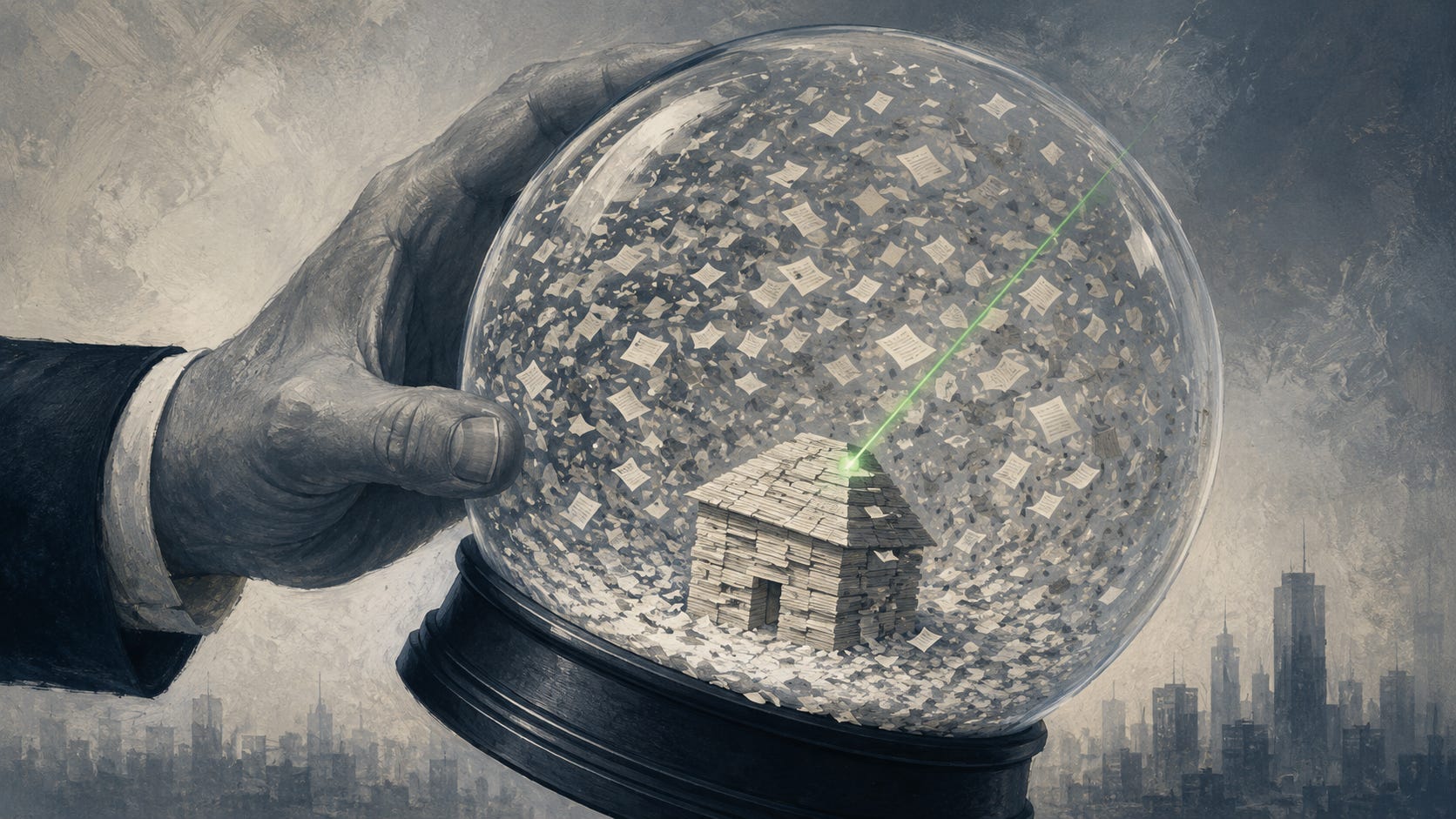
Think of a snow globe. You don’t have to break it to hide the little house inside. You just have to keep shaking it.
That was the tobacco strategy from 1953 onward. Fund friendly studies. Demand “more research.” Put scientists on retainer. Never claim cigarettes are safe, just insist the matter is “controversial.” The 1969 Brown & Williamson memo laid it out in writing, and in 2006 a US federal judge, Gladys Kessler, ruled in a 1,683-page decision that the major tobacco companies had run a decades-long campaign of deliberate fraud, in violation of racketeering law.
The first major reports linking smoking to lung cancer came in 1962 and 1964. Serious US regulation didn’t bite until the 1990s. That’s roughly forty years of shaking the globe, forty years in which millions of people made the most personal decision imaginable, whether to keep smoking, based on manufactured fog.
Note what exposed it: not a gut feeling, not a heroic influencer. Fourteen million pages of the industry’s own documents, forced into the open by lawsuits, now searchable by anyone in the UCSF archive. Evidence caught the liars. Belief kept them in business.
The bakery’s scale: how leaded gasoline stayed legal
Imagine your bathroom scale was calibrated by the bakery down the street. You might reasonably wonder about the numbers.
From the 1920s to the 1960s, essentially all research on the safety of leaded gasoline in America was run by one man: Robert Kehoe, a toxicologist whose laboratory was built, equipped, and funded by the lead industry itself. His rule was simple: show me conclusive proof of harm, or the product stays. Since his lab controlled the data, the proof never arrived.
The man who broke the monopoly was Clair Patterson, a geochemist who wasn’t even studying health. He was measuring the age of the Earth and kept finding lead contaminating everything - his samples, his lab, the air. His 1965 work showed that industrial humans carried vastly more lead in their bodies than pre-industrial people - and that “normal” levels were not “natural” ones, let alone safe ones.
The industry tried to fund him into silence, then tried to defund him out of existence. He won anyway. The US began phasing lead out of gasoline in the 1970s; the last country on Earth stopped selling it in 2021. One retrospective estimate put the annual global damage of leaded fuel at 322 million lost IQ points - a number so large it stops meaning anything until you say it differently: a measurable dent in the intelligence of an entire generation, everywhere, for decades.
The delay was not a scientific failure. The science was falsified, in the honest sense: tested, and eventually corrected. The delay was a sourcing failure. For forty years, almost nobody asked who calibrated the scale.
The false alarm: twelve children and a vanished disease’s return
In 1998, a doctor named Andrew Wakefield published a study of twelve children in The Lancet, suggesting the measles-mumps-rubella vaccine might cause autism. Investigative journalist Brian Deer later showed, in a 2011 BMJ investigation, that the data had been altered in every single one of the twelve cases and that Wakefield had been paid by lawyers suing vaccine makers and planned to profit from diagnostic kits for the scare. The Lancet fully retracted the paper in 2010. Wakefield lost his medical license.
Here’s why that case still matters for the rest of us. A retraction is announcing “false alarm” after the whole building has already run outside. Technically correct. Everyone's still standing in the parking lot.
Measles, a disease the US declared eliminated in 2000, is back: The American Academy of Pediatrics reports that the CDC’s final 2025 tally reached 2,144 confirmed cases, the most in any year since 1991, across 45 jurisdictions and 49 separate outbreaks - and experts believe the real number is significantly higher, since many cases go unreported. Three people died, including two unvaccinated children in Texas: a 6-year-old girl in Lubbock who died of measles pneumonia in February 2025, the first US measles death in a decade, followed by an 8-year-old in the same city weeks later.
The mechanism is not mysterious. CDC data show kindergarten MMR coverage slipped from 95.2% to 92.5% - below the roughly 95% a community needs to stay protected, leaving about 286,000 five-year-olds unshielded, and the disease walked straight through the gap. Roughly 93% of confirmed cases were in people who were unvaccinated or whose status was unknown.
To feel the size of what’s being thrown away: the MMR vaccine is estimated to have prevented 104 million cases and 85,000 deaths in the US between 1994 and 2023. The same modeling work found that if coverage keeps sliding, annual cases could rise more than sevenfold by 2030.
Twelve children. One motivated author. Twenty-eight years of consequences, and counting. That is the exchange rate between a fabricated fact and reality.
When a whole country buys the story
After Germany lost the First World War, a story spread that the army had never really been defeated on the battlefield - enemies of the forces that were driving the newly emerging Weimar democracy instead claimed, that the Reichsheer has been stabbed in the back by traitors at home. The Dolchstoßlegende was contradicted by the military’s own situation reports; the generals who promoted it knew the front had collapsed. But the story did something the truth couldn’t: it took away the pain of defeat and handed people someone to blame. The NSDAP (Germany’s Nazi party that was ruled by Adolf Hitler) built their rise on this lie. A lie that comforts is a painkiller - it doesn’t heal the injury, it just lets you keep walking on the broken leg until it shatters.
The pattern is not owned by any political side. In the Soviet Union, the regime elevated an agronomist named Trofim Lysenko, whose theories flattered communist ideology and contradicted genetics. Scientists who disagreed were fired or imprisoned. Applied to agriculture, Lysenko’s doctrines contributed to catastrophic harvest failures and famine. Ideology got to define the facts and the wheat did not care about the ideology.
That is the common thread from 1919 to 1969 to 1998 to now: reality does not negotiate. It just sends the bill later, with interest.
Why the lie feels better and why that’s not stupid
If you’ve ever been drawn to an “alternative” explanation, you’re not broken. You’ve noticed something true: institutions have lied. Tobacco companies lied. The lead industry lied. A published, peer-reviewed doctor lied. Distrust is not paranoia; it’s pattern recognition.
But look at who unmasked every one of those lies. Court-ordered document releases. A geochemist with a clean room. A journalist reading medical records line by line. A journal issuing a retraction. In every case, the lie was defeated by the boring machinery of evidence: sources, records, measurements, cross-checks. Not once was a major deception exposed by someone who simply felt the official story was wrong and stopped there.
The healthy response to 'they lied to us' is not 'so I'll believe the opposite.' A lie isn't beaten by a better story, it's beaten by going and looking. Pull the document. Find the number. Check who paid for it. The opposite of a lie isn't the version you'd prefer; it's the version you can verify.
The machines arrive
All three of our stories required effort. Kehoe needed a laboratory. Tobacco needed decades of PR budgets. Wakefield needed a medical license and a journal.
Today, a large language model can produce a fluent, confident, footnoted-looking article on any position in seconds - including this one, including its opposite. AI does not know or care whether a claim is true; it produces plausible text. That makes the supply of manufactured doubt effectively infinite and effectively free. The snow globe now shakes itself.
This is not a reason to despair. It’s a reason to change what you check. Fluency used to be a weak signal of credibility - a well-written text probably had an editor, a publisher, something to lose. That signal is now dead. What still works is the thing that always worked: the source underneath the words.
The mug test: opinion versus evidence
You are entitled to your opinions. Everyone is. Whether you like your coffee black is an opinion; nobody can measure it, and nobody should try. Whether the mug is hot is a fact: you can test it, others can test it, and it stays hot whether or not you believe in it.
Three questions separate the two, and they take thirty seconds:
1. Could this claim be wrong and how would we know? A factual claim names conditions under which it would fail. “The vaccine causes autism” is testable - and it was tested, in studies of millions of children, and it failed (Original Source). A claim that cannot fail under any evidence is not a fact. It’s a mood.
2. Who is the source, and who pays the source? Not “which website” — which original document, dataset, or study. Kehoe’s numbers on lead toxicology looked like science. The one question nobody asked for forty years was who funded the scale.
3. What happened when the author was challenged? Real findings survive their critics and get replicated by rivals. Wakefield’s twelve children were never replicated by anyone. Patterson’s lead measurements were replicated by everyone who tried.
Notice what these questions don’t require: trust. You don’t have to trust scientists, journalists, or governments. You have to check whether they’ve shown their work and evidence, unlike authority, invites you to check.
The handrail and the bedrock
Science is not 100% accurate. It never claimed to be, that’s the whole design. It’s a handrail on a dark staircase: it wobbles, it gets repaired, sections get replaced when they fail. The retraction of Wakefield’s paper wasn’t science failing. It was science working - slowly, embarrassingly, but working.
But here is what many people miss: the staircase stands on bedrock, and the bedrock has a name. Mathematics is the one discipline where “provable beyond any doubt” is not a figure of speech. It’s the job description. A mathematical theorem doesn’t rest on measurements, which can be sloppy, or on trust, which can be betrayed. It rests on proof - a chain of logic anyone can check over and over, forever. Around 300 BC, Euclid proved there are infinitely many prime numbers. Every empire that existed then has fallen. The proof still stands, unchanged, and a motivated teenager can verify it in an afternoon.
People sometimes talk as if even math allowed for opinions. It doesn’t, and there’s a clean way to see the difference. Whether prime numbers are beautiful is an opinion, argue about it all night. Whether 17 is prime is not? Try dividing it. You’ll get the same answer as a mathematician in Beijing, a banker in Lagos, and every computer ever built. No authority decreed it; no vote can change it. Mathematicians disagree passionately about what’s interesting or which questions matter, those are opinions. Whether a proof holds, given the stated rules, is not. That’s the sharpest version of the fact/opinion line that exists anywhere, and it’s worth knowing the line can be that sharp.
Now climb the staircase that’s founded by math. Physics is bolted directly to that bedrock: its laws are written in equations, and where they’ve been tested, they hold with almost mathematical force. Your phone’s GPS finds you within a few meters only because Einstein’s relativity is correct to a precision of nanoseconds - you carry the result of this experimental confirmation in your pocket.
That CO₂ absorbs infrared radiation isn’t a modern claim either; John Tyndall measured it on a laboratory bench in 1859, and every spectrometer since has agreed. Chemistry and biology sit further up, where systems get messier and honest science responds not by guessing, but by measuring the mess and printing it. That’s what an error margin is: not a confession of ignorance, but a precise statement of how much is known.
Climate science lives on that staircase, and you can watch it show its work. The IPCC’s latest assessment doesn’t say “the planet has warmed a lot.” It says the surface warmed 1.09°C between 1850–1900 and 2011–2020, with a stated range of 0.95 to 1.20°C and that human activity caused 0.8 to 1.3°C of it, best estimate 1.07°C, while natural forces contributed somewhere between −0.1 and +0.1°C. In other words: essentially all of it, brackets included. Every finding in the report carries a calibrated label - likely means at least 66% probability, virtually certain means 99–100% - and the word “unequivocal,” the strongest in the vocabulary, is used exactly where the evidence has become so overwhelming that doubt is no longer recognizable: human influence has warmed the planet.
And these aren’t just claims about the past - the predictions have been graded against reality. A 2020 study in Geophysical Research Letters went back to climate models published between 1970 and 2007 and checked them against the temperatures that actually happened afterward: accounting for the emissions that actually occurred, 14 of 17 projections matched observations. Models built on 1970s computers, with less processing power than a modern doorbell, predicted the warming you are now living through.
So here is the practical conclusion, and it holds regardless of your politics: you can trust the IPCC’s fact sheets - not because the IPCC is an authority, but because it does the opposite of what every fraud menntioned in this article did. Kehoe hid his data; the IPCC publishes every source. Tobacco sold certainty about safety; the IPCC prints its uncertainty in square brackets on every page. The brackets aren’t weakness. The brackets are the tell of honesty - and their absence, in any confident claim from any side, is the tell of a sales pitch.
You don’t need a laboratory to be part of the correction machinery. Ask for the primary source when someone sends you a claim - the study, the filing, the document, not the screenshot. Check whether a paper has been retracted at Retraction Watch. Read one IPCC Summary for Policymakers yourself - it’s written for non-scientists, and every confidence level is printed right there in the text. Browse the UCSF Industry Documents Library once, just to see what a real cover-up looks like in the perpetrators’ own words - it will permanently raise your standards for the word “proof.”
Keep your opinions. Keep your distrust, even - it’s earned. Just point it at the right target: not at the boring people showing their data, but at anyone, on any side, who asks you to believe without presenting any.